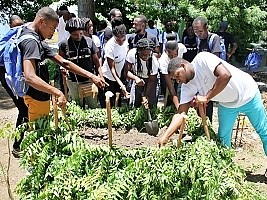
Haiti - Agriculture : Practical training on the manufacture of organic compost
Organic compost is a safe alternative for the protection of the environment and the economic precariousness of young entrepreneurs and farmers, compared to the increasingly exorbitant cost of certain fertilizers in Haiti.
It stimulates microbial activity, reduces disease pressure on the soil, increases organic matter content and improves nutrient availability, among other things. This is why the Institut de la Francophonie pour le Développement Durable (IFDD) has enabled young people from the departments of North, North West, North East and Artibonite to master the techniques of composition of organic compost as part of its practical and ecological training session held in Cap Haitien.
In Cap Haitien, on an area of 1m X 1m X by 0.50m in height, more than 60 young people were able to make two blocks of organic compost with animal waste (cattle, chicken / twalèt bèf ak poul), sugar cane bagasse (pay kann), dry leaves and dry tree branches in the middle and fine-grained sand.
These young people returned home with the ability to increase their plantation thanks to the natural elements found in their environment.
This series of training sessions of the IFDD, a subsidiary body of the International Organization of La Francophonie, is carried out thanks to the financial support of the European Union and the Government of Quebec, with the technical support of the Haitian Youth Observatory.