
|
|
||||||||||||||||||


| 2026-2027 Electoral Calendar, latest official version |

|
 |
|
|
|
|
|
|
|||||||
|
|
Haiti - UEH-CEP Electoral Chair : First big day of exchanges
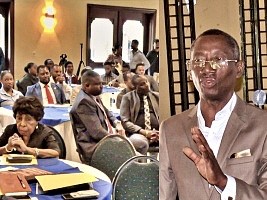
The 2026 electoral process is now at the center of academic and institutional debates. Under the theme "Challenges, issues and opportunities of the next general elections in light of electoral experiences in Haiti", the Chair of Law and Administration of Electoral Operations of the State University of Haiti (UEH) organized its first major day of exchanges at the Karibe Hotel. Launched on July 25, 2025 thanks to an agreement between the UEH and the Provisional Electoral Council (CEP) https://www.haitilibre.com/en/news-45445-haiti-university-cep-and-ueh-join-forces-to-improve-electoral-operations-in-the-country.html , this Chair aims to bring scientific rigor to the organization of national elections. The event brought together electoral advisors, professors, national and international experts, as well as representatives of civil society. Me Florence Mathieu, Representative of the UEH at the CEP, opened the day by encouraging dialogue and serenity. She invited participants to make space a true "laboratory of ideas", positioning the UEH as the compass capable of illuminating the democratic future of the country. Patrick Saint-Hilaire, Representative of the Episcopal Conference of Haiti at the CEP, recalled that the election is above all an act of sovereignty. In a context of crisis of legitimacy and insecurity, he affirmed that credible elections are the only way to restore the authority of the State, declaring "Democracy cannot be decreed: it is built, taught and consolidated." Two major interventions made it possible to paint a realistic picture of the situation : Dong Nguyen Huu, international expert, stressed that elections in Haiti are often dictated by crises (political or natural as in 2010) rather than by a stable periodicity. Despite these weaknesses, he praised the know-how accumulated by the Haitian electoral administration since 1990, which now needs to be modernized. Me Carlos Hercule former member of the CEP, identified the major obstacles to the success of the 2026 election "“Dysfunctions of the National Identification Office (ONI) and lack of coordination; Control of strategic areas by armed groups and international financial dependence", concluding that the conditions for success are "the neutrality of the executive, the reliability of the electoral lists and the modernization of litigation." Me Paul Rachel Cadet, expert in violence management, presented an alarming observation "participation fell from 70% in 1990 to around 20% during the last elections. To reverse this curve, he proposes: Restoring trust : Total transparency and digital traceability; Civic education : Transform voting into an act of dignity rather than a source of fear; The fight against impunity : Severely sanction electoral violence and violations. The consensus of this first major day of discussion is clear: the success of 2026 is not just a technical question. It is based on a profound overhaul of governance. Professor Jean Eugène Pierre-Louis (UEH) concluded by calling for a global patriotic commitment to make these games the 'royal road' to stability." The Electoral Chair now stands out as the strategic pivot for anchoring Haitian democracy on scientific and sustainable foundations. HL/ HaitiLibre
|
|









|
|
Why HaitiLibre ? |
Contact us |
Français
Copyright © 2010 - 2026 Haitilibre.com |